Fuel prices move every few months, so any article that quotes a fixed naira figure is out of date quickly. Instead, here is a simple method to work out what your generator really costs you, compare it with solar, and decide with today’s numbers.
Step 1: How much power do you actually use?
Everything starts with your daily energy use in kilowatt-hours (kWh). Add up what you run during outages:
| Appliance | Typical power | Hours a day | Energy a day |
|---|---|---|---|
| Lights (10 LED bulbs) | 100 W | 6 | 0.6 kWh |
| Fridge | 150 W when running | 24 (runs about a third of the time) | 1.2 kWh |
| TV and decoder | 120 W | 5 | 0.6 kWh |
| Fans (3) | 210 W | 8 | 1.7 kWh |
| Laptops, phones, Wi-Fi | 100 W | 8 | 0.8 kWh |
| Total | about 4.9 kWh |
Air conditioners change the picture completely: a single 1.5 HP unit can use 1–1.5 kWh every hour it runs. That is why we always do a load audit before designing anything.
Step 2: What does a kWh from your generator cost?
Small petrol generators are inefficient, especially when they run lightly loaded. In practice, a small home generator produces somewhere around 1 to 2.5 kWh for every litre of fuel, depending on its size, age and how much load is on it.
Generator cost per kWh ≈ fuel price per litre ÷ kWh per litre
For example, if your generator gets about 1.5 kWh per litre, every kWh costs you the price of two-thirds of a litre of petrol. Then add:
- Servicing: oil changes, plugs and filters every few weeks of heavy use.
- Repairs and replacement: small generators running daily often need a major repair or replacement within a few years.
- Your time: buying fuel, queues and scarcity.
Multiply your daily kWh by this cost per kWh, and by 365, to see your yearly generator cost. Most families are surprised by the total.
Step 3: What does a kWh from solar cost?
Solar has a high upfront cost and almost no running cost. To compare fairly, spread the system price over the energy it will produce:
Solar cost per kWh ≈ (system price + battery replacements) ÷ (daily kWh × 365 × years of life)
Panels typically last 20 to 25 years, inverters around 7 to 10, and batteries depend on the type (lithium usually lasts much longer than lead-acid; see our battery article). Abuja gets good sunlight most of the year, though the rainy season and harmattan haze reduce output, so systems are sized for the worst month, not the best.
Step 4: Compare, and look at the payback
Divide the solar system price by the yearly generator cost you worked out in Step 2. That is roughly how many years until solar has paid for itself. For homes that run a generator many hours a day, the payback is often a few years. For homes that rarely lose power, it is longer, and a smaller inverter-and-battery system may be the better first step.
You do not have to choose one
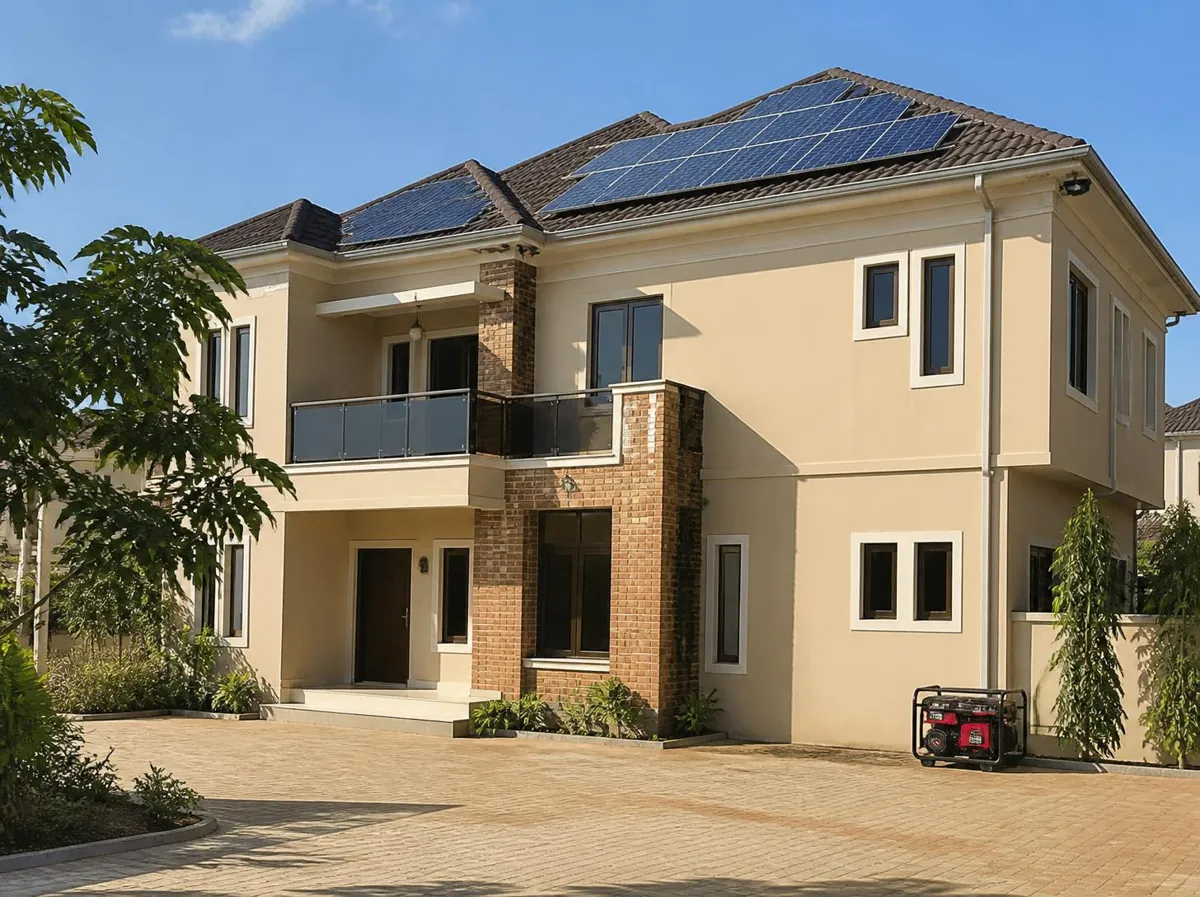
Most of our clients keep their generator. A hybrid system runs the house on solar and batteries, and only starts the generator when the battery is low after several cloudy days. The generator runs far less, lasts longer and burns much less fuel.
The costs that are not on the receipt
- Noise and fumes. Generators are loud, and their exhaust contains carbon monoxide. Never run one indoors, in a garage or near windows.
- Clean power. Solar inverters give stable power that is kinder to electronics than many small generators.
- Reliability. No fuel queues, no scarcity, and no night-time trips to switch over.
How we size it
We start every solar job with a load audit: what you run, for how long, and when. From that we size panels, inverter and batteries for your real needs, show you the expected savings against your generator, and design a hybrid system if you want to keep the generator as a backup.